

New Missiles But Fewer Launches, a Missile Sub Reveal, and a Nuclear-Armed Air Force
This article is from the third edition (October-December 2025) of 38 North’s quarterly product, North Korea Briefing, that monitors key internal developments in North Korea. For the full series, click here.
During the fourth quarter of 2025, North Korea unveiled a new solid-propellant intercontinental ballistic missile (ICBM), a new version of the KN-23 short-range ballistic missile (SRBM), and a new probably conventional air-launched cruise missile (ALCM). However, the year 2025 featured fewer total ballistic missile launches than for each year from 2022-2024—and no ICBM launches, deepening North Korea’s prior emphasis on theater missile activities. Pyongyang revealed for the first time most of the hull of the nuclear-powered ballistic missile submarine (SSBN) under construction. And Kim Jong Un announced the Air Force would be assigned a nuclear deterrent mission, which at least initially appears to entail operating road-mobile launchers for dual-capable land-attack cruise missiles (LACMs).
New and Modified Missiles at Arms Expo and Parade
The North unveiled what it termed the “new” Hwasong-20 (HS-20) solid-propellant road-mobile ICBM and a new version of the KN-23 solid SRBM carrying a hypersonic glide vehicle (HGV) at the early October “military hardware exhibition Defense Development-2025” and October 10 military parade in Pyongyang. These and other revelations at the arms expo and parade were reported extensively on 38 North on November 4.
Context and Implications
The exhibition and parade did not reveal any dramatically new ballistic missiles. The “new” HS-20 appeared to offer little more than the previous HS-19 ICBM, and the addition of an HGV to the KN-23 SRBM will likely make a marginal improvement to missile defense penetration, assuming it is deployed. This should not be surprising given prior improvements to the large variety of missile systems the North has unveiled since 2019, providing Pyongyang updated, mature missile systems across the entire spectrum of ranges. Therefore, aside from multiple warheads if they are successfully developed, future improvements are much more likely to be incremental—although the North probably will continue to increase the overall number of missiles and launchers deployed.
Fewer Missile Launches in 2025, but It’s Not Just the Numbers
The October 23 Wall Street Journal reported that North Korea “sharply reduced” the number of missile launches conducted in 2025 compared to each year between 2022 and 2024. It attributed the reduction to Pyongyang’s increased confidence (which reduced its need to “seek attention” with launches) and a shift from launches to factory visits and declarations by Kim Jong Un as a means to “convey North Korea’s military strength.”
Context and Implications
North Korea has reportedly conducted some 15 ballistic missile launches in 2025, compared to 41 in 2024, 31 in 2023, and 69 in 2022. More interesting than the numbers is the fact that all but one of the 2025 launches were SRBMs (an intermediate-range ballistic missile was launched in January), deepening 2024’s emphasis on theater missile activities. This also means no ICBMs or submarine-launched ballistic missiles (SLBMs) were launched in 2025. Only one ICBM—the first and only HS-19—was launched in 2024, and the North has not launched a purpose-built SLBM (as opposed to a sub-fired KN-23 SRBM) since 2019. The recent emphasis on theater missiles is underscored by adding in LACM launches: at least 10 or so were reportedly launched in 2024 and 12 in 2025, including two reportedly observed by Kim Jong Un on December 28.
It is highly debatable whether the North really cared about “seeking attention” with missile launches, especially after its apparent rejection of improved relations with the West in the wake of the failed 2019 Hanoi summit. That said, it would not be surprising if political motivations played an important role in the decision to launch fewer missiles and no strategic systems in 2025, since in Pyongyang political motivations for missile launches are probably more important than technical and operational ones. However, other factors probably contributed as well, including the completion of several missile development programs, a likely priority on exporting KN-23 and possibly KN-24 SRBMs to Russia for use against Ukraine, a possible desire to supersede the HS-19 ICBM with an announced new version incorporating the same more powerful first stage that is being developed for the HS-20, and the lack of an available missile submarine large enough to deploy the newer SLBMs North Korea has displayed but not yet flight-tested.
More of the New “Nuclear-Powered” Submarine Hull Revealed
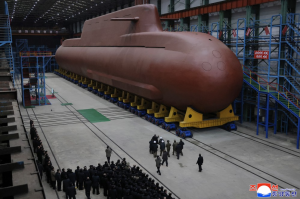
North Korean press on December 25 reported on a recent visit by Kim Jong Un to the construction site for a “8,700-tonnage nuclear-powered strategic guided missile submarine.” Associated photos looking up from below showed most of the submarine inside its construction hall.
Context and Implications
The previous images of the sub this March only showed the lower portion of part of the hull. Although possibly retouched, the new photos appear credible. In addition to six torpedo tubes in the bow, the new photos reveal an extended-length sail containing 5-10 probable ballistic missile launch tubes akin to the former Soviet Golf-III/Project 601 diesel/electric missile sub. (As the new sub is not seen from above, the number of missile tubes cannot be confirmed.) Housing the missile tubes in the tall sail instead of a shorter “turtleback” section aft of the sail, like most of the world’s missile subs do, suggests the new sub is intended to accommodate SLBMs that are much longer in size—at least 14 meters and even 18 meters long. (The longest SLBM displayed by the North to date, in April 2022, was some 13.5 meters long.) A longer missile may be needed to reach intercontinental range, an objective set out by Kim in January 2021.
There is no open-source reporting that North Korea has yet built or tested a submarine nuclear reactor, and the new photos do not reveal whether one is installed in the new sub. At this point, the idea that the hull is equipped with an operable nuclear reactor should be regarded with great skepticism, although this possibility cannot be ruled out—especially if Russia provided a reactor or extensive technical assistance (of which there is little evidence to date). Even if the sub is reactor-equipped, a year or two of fitting out probably would be required before it rolled out of the construction hall ready to begin sea trials, with additional time required to reach operational status.
Air Force to Add Nuclear Deterrent Mission
North Korean press reported a November 28 visit by Kim Jong Un to an airbase marking the 80th founding anniversary of the North Korean Air Force. Kim noted “that the Air Force will be given new strategic military assets and entrusted with a new important duty,” and “will play a role in the exercise of the nuclear war deterrent.” Accompanying photos of a weapons display at the airbase showed a road-mobile LACM launcher, three different Hwasal-class LACMs, and a new-type tactical ALCM on a Su-25 Frogfoot ground attack jet.
Context and Implications
Kim did not specify what the Air Force’s new nuclear role will entail, but the display implies at least some LACM launchers will be subordinated to the Air Force and equipped with all three known Hwasal missile variants. The Air Force LACMs probably will be in addition to those already under the Strategic Forces. This is probably the most sensible way to give the Air Force a nuclear role, as road-mobile LACMs are more survivable both pre-launch and in-flight than Pyongyang’s obsolescent combat aircraft, and have enough range (1,500-2,000 km) to cover all of South Korea from anywhere in the North.
The size and square cross-section of the new ALCM resemble the German-Swedish Taurus missile exported to South Korea and the Russian Kh-69. The missile’s range and payload capabilities are unknown but are probably much less than the Hwasal LACM. The new ALCM probably would be more suitable for conventional than nuclear strike missions. Future development of longer-range nuclear ALCMs cannot be ruled out, especially if the North can acquire more capable aircraft to carry them. However, air-delivered nukes will likely remain a minor player in a North Korean nuclear force dominated by road-mobile ballistic and cruise missile systems.