

A New Look at North Korea’s Economic Redistribution During the COVID-19 Pandemic
Evidence from nighttime satellite imagery indicates that the distribution of economic activity in North Korea (Democratic People’s Republic of Korea or DPRK) shifted during the COVID-19 pandemic’s critical phase. The Kim regime appears to have redistributed economic activity by insulating Pyongyang, expanding agricultural production, and increasing activity in districts with nuclear and chemical facilities, while outlying districts saw comparatively smaller gains. This redistribution suggests that in the event of another global economic disruption, North Korea will likely follow a similar strategy, concentrating resources in Pyongyang and strategic sectors, increasing vulnerability among citizens in lower songbun classes who may be forced to bear a disproportionate share of the resulting economic burden. These findings highlight the importance of international efforts to reestablish capacity-building programs in North Korea to help mitigate hardship for North Koreans in future economic shocks.
Introduction
Kim Jong Un made sweeping changes in North Korea’s economy since his rise to power in late 2011, effectively allowing for greater market influence in North Korea’s industrial and agricultural sectors. However, it was previously unknown how his regime would respond to a global negative economic shock. That is, until the international outbreak of COVID-19.
Because North Korea is one of the most closed off countries in the world, this makes traditional methods of determining how the pandemic affected North Korea’s economy—such as analyzing publicly available economic data—a difficult puzzle. One recent paper looked at nighttime images of North Korea from January 2020 to January 2022 to determine how Pyongyang redistributed economic activity during the pandemic, building off previous studies that have established nightlight intensity as a reliable proxy for economic activity.
This article discusses major implications based on this paper of how North Korea’s economy adjusted to the pandemic, touching on the following key issues:
- What do we know so far about North Korea’s public pandemic response?
- How did North Korea adjust its pandemic economy in Pyongyang vs. outside regions?
- How was North Korea’s economic activity redistributed by sector?
- Do these trends hold for pre-pandemic and post-pandemic periods?
- What are the implications of this economic redistribution?
Methodology and Key Findings
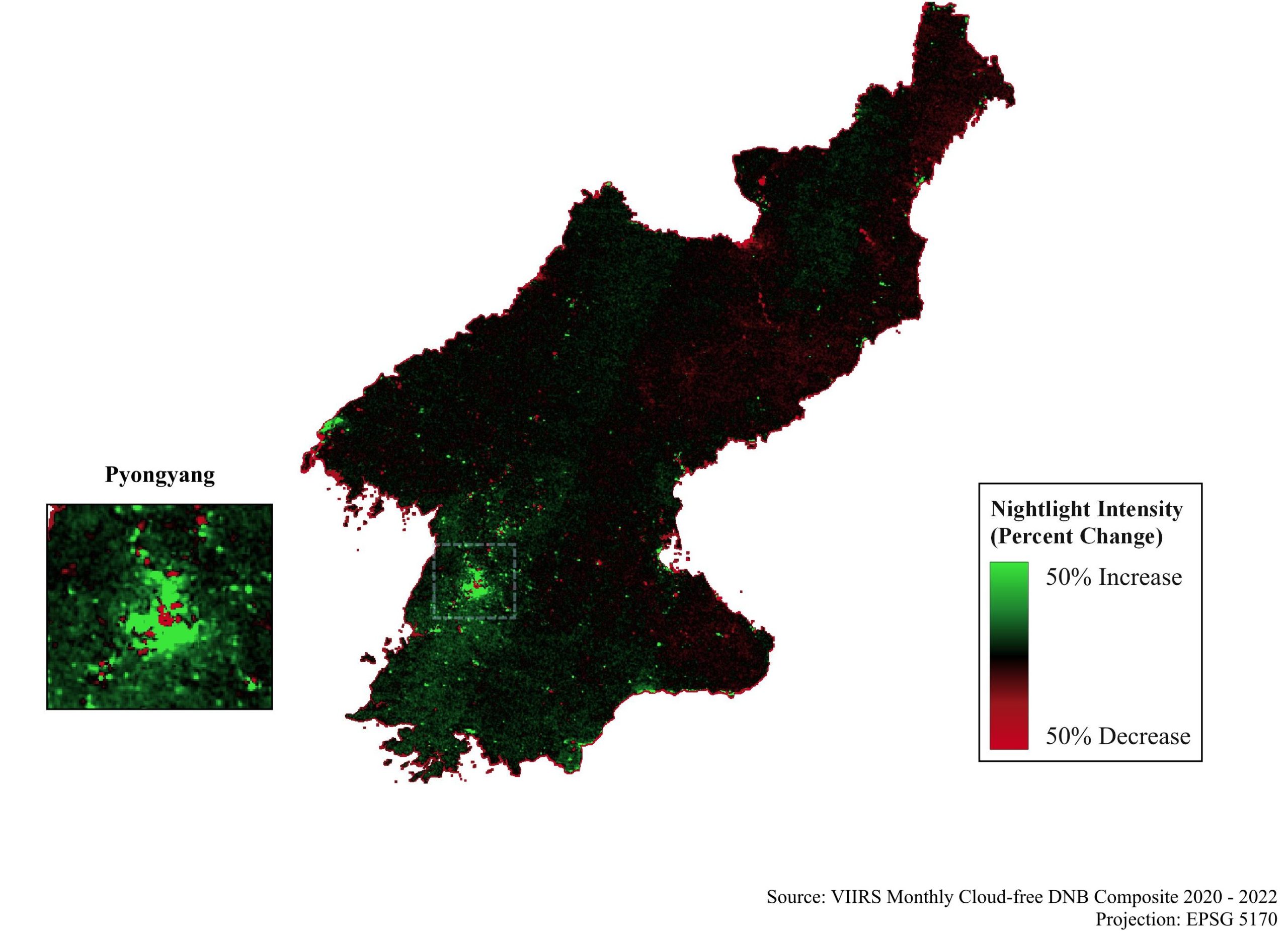
The map above was created by compiling and analyzing monthly cloud-free VIIRS Day/Night Band images from the Earth Observation Group (EOG) from January 2020 to January 2022. These monthly images were processed before compiling them to minimize errors from cloud cover and stray light in the atmosphere. Each pixel in the images and the resulting map are approximately 750 meters, which is detailed enough to determine differences in radiance by district and other moderate scales, but not at smaller scales (such as between individual buildings).
We analyzed these images to determine how nightlight intensity (and therefore, economic activity) changed in districts throughout North Korea during the pandemic. Additionally, district and provincial level differences in nightlight intensity were analyzed to discover how economic activity was redistributed between sectors of the economy. For instance, if districts known for agricultural output saw increases in nightlight intensity during the study period, this indicates that agricultural output itself might have increased. Bright green spots on the map above indicate an average increase in nightlight intensity by approximately 50%, while bright red spots on the map indicate an average decrease in nightlight intensity by approximately 50%.
Using the geospatial results, we calculated the mean nightlight intensity changes for North Korea in each study period, as well as changes by province and by sector. These results are shown in Table 1 at the end of this article and will be referred to throughout this analysis.
Pyongyang’s Public Response to COVID-19
North Korea did not report any domestic cases of COVID-19 until May 2022, more than two years into the pandemic. Only three months later, North Korea declared itself free of COVID-19 within its borders. Many outside observers questioned this claim given North Korea’s limited national health care system and late rollout of domestic vaccinations against COVID-19, along with the country’s sizable number of citizens with immune system vulnerabilities from malnutrition, making disease spread more likely. A recent report that observes 100 North Korean citizens’ responses regarding their experiences during the pandemic lockdown casts further doubt on the veracity of this claim.
Pyongyang’s Economic Insulation from the Pandemic
Most provinces in North Korea saw at least slight increases in nightlight intensity from January 2020 to January 2022, a critical phase of the pandemic. However, districts further from the capital saw slighter increases, while districts close to Pyongyang and Pyongyang itself saw the largest increases in nightlight intensity. For example, Pyongyang itself had a 56.7% increase in nightlight intensity, South Hamgyong (a province in the western part of North Korea, a relatively medium distance from Pyongyang) had a 29.3% increase in nightlight intensity, and North Hamgyong (a province on the northeastern tip of North Korea, a relatively far distance from Pyongyang) had only a 21.6% increase.
These results have two implications. First, these results suggest that COVID-19 may not have had a severe economic impact in North Korea. This could be explained in a few ways. It is possible that—if North Korea had low levels of economic activity or faced an economic downturn pre-pandemic—there could have been increases in economic activity even during the pandemic, since these results measure relative changes in economic activity vis-à-vis nightlight intensity during the pandemic period. In addition, previously implemented international sanctions on the DPRK could have forced the country to become more insular and economically self-sufficient, which could mean that the country would be less impacted by the global economic slowdown during the pandemic.
Second, these results indicate the North Korean government likely made efforts to further insulate individuals within Pyongyang, including government officials, technocrats, and other citizens falling within the highest songbun status (the state’s official political classification system based on loyalty to the Kim regime, with those of highest status often living in the capital), from the pandemic’s economic fallout. While this result may sound surprising, it actually follows a historical precedent: during North Korea’s Arduous March in the mid-to-late 1990s, flooding-induced famine led to the loss of between 3% and 5% of the population from hunger and disease, but defector accounts from that period mention that government officials and other high status individuals in Pyongyang were well fed and insulated from much of the famine.
Additionally, it is possible that North Korea’s electricity generation capacity substantially improved shortly before the pandemic, which would have insulated the country from much of the pandemic’s economic shock. Improving electricity generation has been a goal of the Kim regime, and given North Korea’s frail energy transmission networks, the regime has prioritized hydro power stations that can be completed quickly and supply electricity to local areas. Reports indicate that multiple power station components were completed shortly before the pandemic, including the large-scale Phalhyang Dam in North Hamgyong in December 2019.
According to Statistics Korea, overall power generation in North Korea from 2019 to 2021 rose over seven percent from 23.8 TWh to 25.5 TWh, further supporting this possibility.
Economic Activity Redistribution by Sector
Looking by sector, mining and manufacturing districts saw an approximately 40% increase in nightlight intensity, while agricultural districts saw a sizable increase in nightlight intensity of over 59%. Given that pandemics increase demand for food resources (sick people need to consume more calories to fight disease), and that Chinese exports to North Korea reduced by 81% in 2020 (declining even further in 2021), it is reasonable to assume that the North Korean government would have redistributed economic activity towards agricultural districts to increase food output for citizens.
Surprisingly, districts with known missile launch sites, nuclear facilities, and chemical facilities all saw substantial increases in nightlight intensity during the pandemic as well (between 34% and 43%). While international watchdog reports showed a lower amount of missile launches and nuclear tests in North Korea in 2020 and 2021 compared to previous years (2014–2017, 2019) and compared to 2022, these results indicate that the DPRK continued to invest heavily in nuclear and chemical facilities development during the pandemic.
Pre- and Post-Pandemic Context
North Korea initially appears to have not had severe economic impacts stemming from the pandemic. But what if North Korea had faced a pre-pandemic domestic economic downturn, and the results we see are influenced by the recovery period stemming from this economic downturn? Without a baseline comparison before the pandemic, it is hard to understand if what is observed over this period follows a normal trajectory for North Korea, or is unique to the Kim regime’s economic response to the pandemic. Therefore, this study also examines the two-year pre-pandemic period from January 2018 to January 2020.
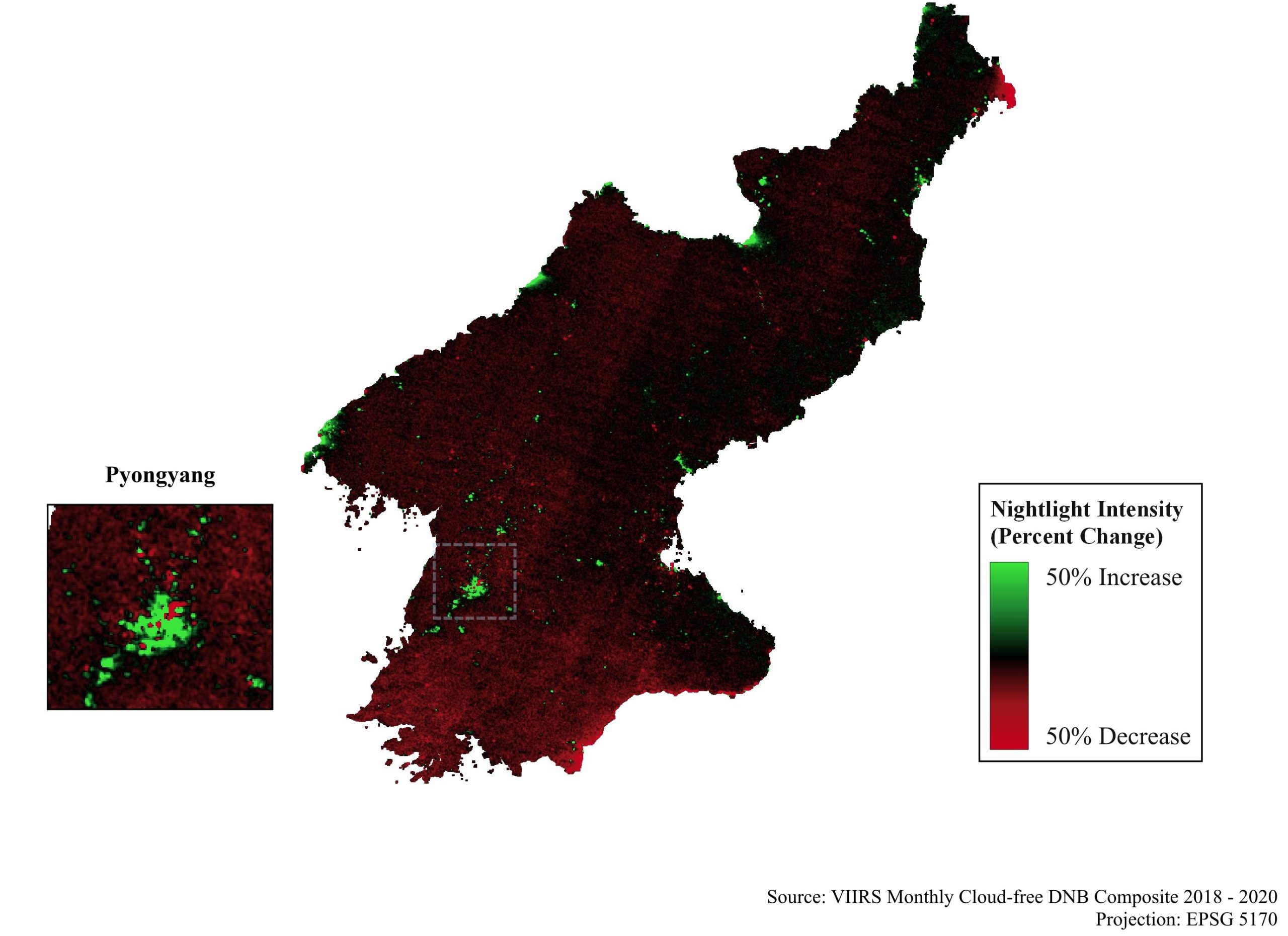
The results show that during that period, there was an average decrease of nightlight intensity of 36.8% throughout the country. This indicates that North Korea had experienced a period of economic hardship prior to the pandemic, which helps to explain the relative increases in nightlight intensity throughout North Korea during the pandemic years. Notably, there were decreases in economic activity across sectors (28.8% decrease in mining districts, 23.5% decrease in manufacturing districts, and 55.6% decrease in agricultural districts), as well as districts with nuclear facilities (18.7% decrease), districts with missile launch sites (26.9% decrease) and districts with chemical facilities (15.7% decrease). Notably, central Pyongyang experienced an increase in nightlight intensity, which supports the idea that the regime made an effort to insulate Pyongyang from economic hardship.
Looking at this control period provided important context for assessing the economic impact of COVID-19. Another critical question is whether the trends observed during the pandemic continued after the critical phase of COVID-19 ended; for example, when were mass vaccinations introduced in North Korea and when did borders begin reopening? Therefore, an additional assessment of the period from January 2022 to January 2023 was also conducted.
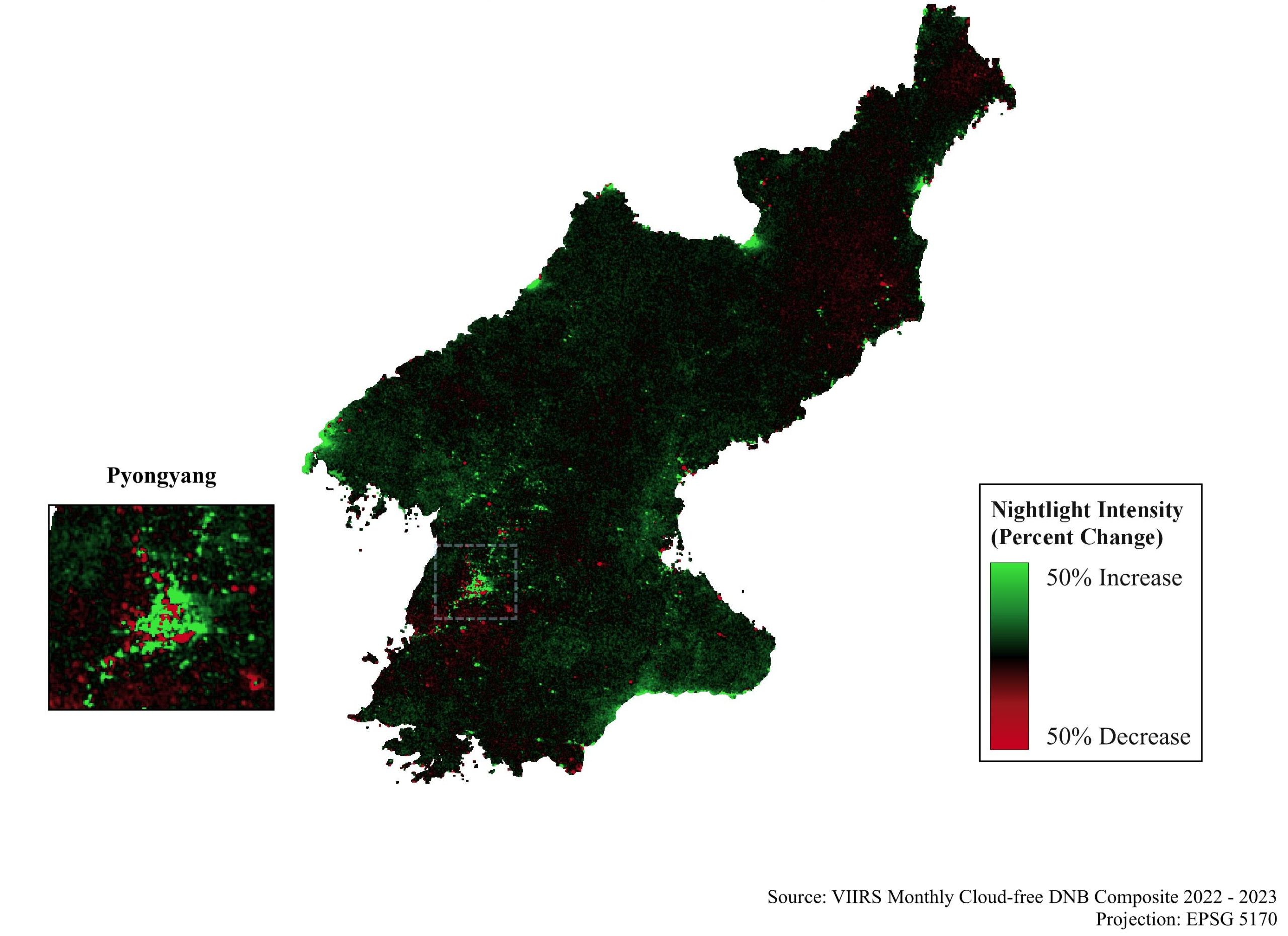
These results show an interesting trend: across North Korea, there are significant increases in nightlight intensity in regions outside of Pyongyang, indicating a return to normalcy for the country after the critical phase of the pandemic. However, Pyongyang only realized a 9.7% increase in nightlight intensity during this period, which is smaller than the pre-pandemic and critical pandemic phase periods investigated earlier. Manufacturing, agriculture, and mining districts all saw increases in nightlight intensity, although these increases were relatively smaller than during the pandemic period. Additionally, districts with nuclear facilities, chemical facilities, and missile launch sites all saw smaller increases in nightlight intensity than during the pandemic period, supporting the previous idea that Pyongyang recognized a unique opportunity to invest in these sectors during the pandemic.
Implications
Taken together, these exploratory results suggest the North Korean government may have insulated Pyongyang from the economic effects of the pandemic, while also bolstering its nuclear and chemical facilities development. Districts farther from the capital saw relatively smaller increases in economic activity during the pandemic, some of which could have simply been a natural response to the economic downturn during the pre-pandemic period. North Korean citizens in these districts, who were often of lower songbun status and among the most vulnerable in North Korea, may have needed to work harder to make up for the additional resource consumption in Pyongyang and weapons development zones, especially given the halting of trade with China. This is supported by the relatively large increases in nightlight intensity in agricultural regions during the pandemic and indicates that the citizens outside of Pyongyang could have faced added strain during the pandemic, although further analysis is needed to determine the direct effects on North Korean citizens stemming from any economic downturn during the pandemic.
Outlook for Future Negative Economic Shocks
While nightlight data should not be interpreted as a complete representation of the economic situation in North Korea, it provides a glimpse into how the North Korean government adjusted economically to the pandemic. It also provides some indication of how the North Korean regime may respond to future negative economic shocks. It is clear North Korea greatly values its citizenry and elites in Pyongyang and having nuclear capabilities, given the evidence of Pyongyang’s economic insulation and continued nuclear development during the critical pandemic years. This is likely to be repeated in the event of another global negative economic shock—whatever that may be—even if this means moving economic resources away from other sectors of the economy. This could have dire consequences for North Koreans in lower songbun classes, who already have less access to food, medicines, and other essential resources in non-crises times.
Before the next economic shock occurs, the global community could help North Korea build up capacity and resiliency against future shocks, especially for North Korea’s rural populations. Despite multiple factors that limit aid efforts to North Korea, the DPRK has selectively engaged in cooperation and capacity-building programs with international and non-government organizations, primarily in the fields of health and agricultural development cooperation. If these capacity-building programs could be reestablished with North Korea—and North Korea is willing to accept these resources and support—it could help alleviate any potential strains on North Koreans during the next economic shock in the DPRK.
Note: The regions of Pyongyang, Kaesong, Rason, and Ryanggang, as well as Nuclear Facilities, Missile Launch Sites, and Chemical Facilities contained relatively few observations. As a result, statistical significance is difficult to establish. These results may reflect real effects, but the limited data prevents us from drawing firm conclusions.