

North Korea Tests New Theater Launch Platforms as Party Congress Continues Nuclear/Missile Buildup
This article is from the fourth edition (January – March 2026) of 38 North’s quarterly product, North Korea Briefing, that monitors key internal developments in North Korea. For the full series, click here.
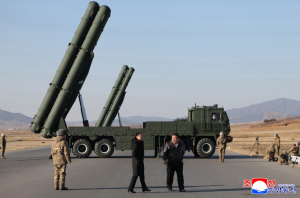
The Ninth Party Congress in February committed North Korea to building more nuclear weapons and more existing-type nuclear delivery systems. The report singled out the dual-capable KN-25 short-range ballistic missile (SRBM), which the North launched in January and March from a new road-mobile launcher (50 of which were presented to Kim Jong Un in mid-February) and reportedly incorporated a new guidance system. The report also endorsed the “nuclear weaponization of naval surface forces.” Shortly after the Congress, 11 nuclear-capable land-attack cruise missiles (LACMs) were launched over two days in March from the North’s first new destroyer-type warship, now undergoing sea trials. In addition to meeting Pyongyang’s nuclear expansion goals, further KN-25 and LACM deployments bolster conventional strike capabilities against South Korea that the Congress report said needed to be “greatly increased.”
Ninth Party Congress Continues Nuclear/Missile Buildup
On February 26, North Korean media released the report on that month’s Ninth Party Congress, although with significantly fewer military specifics than provided in the previous one in January 2021.[1] What was clear, however, is that the country will continue its ongoing “very satisfactory” effort to increase the number of nuclear weapons, and “accelerate the deployment of already-developed” nuclear delivery systems. The report singled out “ICBM [intercontinental ballistic missile] complexes of ground and underwater launching,” the “nuclear weaponization of naval surface and underwater forces,” and reinforcing deployments of the KN-25 and other unspecified SRBMs. The new report also flagged for the first time plans for “special assets for attacking the enemy’s satellite in emergency.” (38 North previously provided additional analysis of the new report, and a rundown of how far the North got with the nuclear/missile systems specified in the 2021 report.)
Context and Implications
Pyongyang has been increasing its infrastructure to produce fissile material, missiles, and road-mobile launchers, and thus appears well configured to continue building up nuclear weapons and all range classes of ballistic missiles. The new report’s mention of ICBMs was not limited to solid-propellant systems as in 2021, possibly suggesting the parallel build-up of liquid ICBMs. (That said, on March 29 the North reported its first static (ground) test of an ICBM-class solid-propellant rocket motor since a test associated with the new Hwasong-20 solid ICBM in September 2025; as reported previously in 38 North, it is unclear which missile system the “newly upgraded,” higher-thrust motor is associated with.) The nuclear-powered ballistic missile submarine (SSBN) effort was not singled out as in 2021, but references to “underwater launching” ICBMs and the “nuclear weaponization of… underwater forces” presumably mean that program will continue.
Although the KN-25 and other SRBMs can deliver tactical nuclear and chemical weapons, they also have critical conventional roles the report recognized in the context of “greatly increas[ing] the density and durability of concentrated attack” against South Korea. In at least the near-term, the new focus on anti-satellite (ASAT) systems probably involves electronic warfare (also highlighted in the report). Pyongyang can also develop direct-ascent ASAT interceptors (although effective conventional payloads would be technically challenging) and use its existing nuclear-armed ballistic missiles in an “emergency” to attack satellites.
KN-25 SRBM Buildup Highlighted in the Run-up to Party Congress
North Korean media reported a January 27 launch of four KN-25 “large-caliber multiple-launch rockets” that had been upgraded to incorporate a new “self-steered precisely guided flight system, which can neglect any outside intervention.” The missiles were launched from a “newly-modernized” four-axle road-mobile launcher with five missile launch tubes. The upgraded missile reportedly demonstrated improved “intelligence and hitting accuracy.” Media also reported the February 18 presentation to Kim Jong Un of 50 new-type KN-25 launchers produced over two months. In an associated speech, Kim claimed the “super-precision” system “incorporates AI technology and compound guidance.” On March 14, a “firepower strike drill” featured 12 new-type launchers each firing one KN-25 in a “concentration strike” that “will be frequently conducted in the future.”
Context and Implications
KN-25s have made up the bulk of North Korea’s missile launches over the past two years, and the new Congress report clearly highlighted the system’s utility against South Korea (see above). The new 5-tube launcher (first seen in December 2025) adds to the previous 4-tube platform, and the large number of new launchers unveiled (capable of carrying 250 missiles, well in excess of the assessed size of North Korea’s nuclear stockpile) underscores the KN-25’s important potential in conventional warfare for saturating and suppressing missile/air defense systems, airbases, counterbattery radars, and other targets critical to alliance military operations. Even so, the North stated the March drill will provide “a deep understanding of the destructive power of tactical nuclear weapon.”
The new “self-steered” guidance may be an all-inertial system that does not use GPS or other external updates, perhaps prompted by the heavy use of electronic warfare in Ukraine to degrade GPS-guided munitions. Such a guidance system is unlikely to be as accurate as a GPS-aided one, especially over ranges such as the 358.5 to 364.4 km claimed for the January and March launches. (Inertial accuracy degrades with range; Pyongyang claimed in March the KN-25 could reach 420 km, and 400 km has been seen in testing.) One way to have autonomous guidance without external updates would be to incorporate a terminal radar or optical seeker (which might be part of a “compound guidance system”), but no signs of a seeker have been seen on KN-25 missiles to date. Although military AI also was highlighted in the Ninth Party Congress report, the nature of any “AI technology” in the KN-25 is unknown; possibilities range from use in the targeting system aboard the launcher, to the software for any terminal seeker, to simply being a propaganda claim.
Nuclear-Capable LACM Firings During “Shakedown” of North’s First Destroyer
North Korea’s first destroyer-type warship, the Choe Hyon, reportedly launched five Hwasal-class “strategic” land-attack cruise missiles (LACMs) on March 4 as part of the new ship’s sea trials (“shakedown”) prior to deployment. Six more LACMs were launched from the ship on March 10, reportedly using the “national integrated control system of strategic weapons.” Kim Jong Un reportedly said the North “must” build two destroyers or larger cruisers every year of the new five-year plan (2026-2030) and would step up the construction of the third Choe Hyon-class destroyer so it would be completed by the anniversary of the founding of the Korean Workers Party on October 10. (The second such ship foundered during its original launch in May 2025, was subsequently refloated, and has since been undergoing repairs.)
Context and Implications
Kim has been stressing since September 2023 the importance of deploying nuclear weapons in the navy, stating this March that the effort “is making satisfactory progress.” Putting nuclear-capable LACMs on surface ships in the near term meets this objective until the eventual potential deployment of ICBM-class missiles on SSBNs. As the United States has demonstrated in various conflicts since the 1990s, ship-launched LACMs can also fulfill useful conventional roles. Shipborne LACMs help diversify and improve the overall survivability of the overwhelmingly land-based North Korean missile force, although individual ships would be highly vulnerable to allied attack in wartime.
Analysis elsewhere has pointed out that 10 vertical launch system (VLS) hatches/launch tubes apparently sized for KN-23 SRBMs, seen farthest aft on the superstructure of the first Choe Hyon when it was launched in April 2025, were replaced with 24 smaller hatches/tubes by October 2025, and that additional VLS sections with 10 more such hatches/tubes were added to either side of them by the time of the March 2026 sea trials. This suggests that, if the North originally intended to deploy SRBMs on the Choe Hyon, it subsequently decided to rely solely on LACMs for the ship’s theater-range strike capability. Although potentially more vulnerable to defenses than KN-23s, Hwasal-class LACMs have longer range (1500-2000 km, compared to upwards of 800 km for the KN-23) that offers greater target coverage and/or the ability to deploy farther away from threats to the launch platform.
- [1]
For more on this author’s initial assessment of the Ninth Party Congress, see Rachel Minyoung Lee, Kibum Han, Vann H. Van Diepen, Gyeong Seob Oh, Michael Madden and Mitsuhiro Mimura, “Expert Takes on North Korea’s Ninth Party Congress,” 38 North, February 27, 2026, https://www.38north.org/2026/02/expert-takes-on-north-koreas-ninth-party-congress/.