

North Korea’s Expanding Production of Uranium and Conventional Missiles
This article is from the fifth edition (April-June 2026) of 38 North’s quarterly product, North Korea Briefing, that monitors key internal developments in North Korea. For the full series, click here.
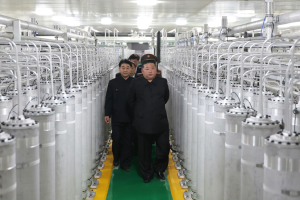
North Korea announced in June a new uranium enrichment facility, probably at Yongbyon, capping off a doubling of weapons-grade material production capacity between 2021 and 2025. An updated version of the country’s apparent constitution, revealed in May, included a provision for the head of state to “delegate” nuclear use authority. This almost certainly did not change Pyongyang’s longstanding practices, but it reinforced its claim to nuclear-weapons-state status while serving to deter Alliance pursuit of “decapitation” attacks. The North revealed a new, 100-km range “tactical cruise missile” in May, and in June a plan to increase by 2.5 times over the next five years its production capacity for ballistic and cruise missiles—probably mostly conventionally-armed. All of these activities are consistent with the February 2026 Ninth Party Congress’ emphasis on increasing the number of nuclear weapons and short-range ballistic missiles (SRBMs).
New Centrifuge Uranium Enrichment Facility Inaugurated
On June 3, Kim Jong Un visited a “newly-inaugurated nuclear materials production factory.” During the visit, Kim claimed that “the weapons-grade nuclear materials production capacity more than doubled” under the Eighth Party Congress (2021-2025), and that “the nuclear materials production sector is correctly implementing” the “strategic decision to further expand the nuclear materials production capacity” adopted at the Ninth Party Congress.
Context and Implications
The International Atomic Energy Agency (IAEA) reported June 8 that “the interior structure and layout of the facility” shown in photos of Kim’s visit “is consistent with…the features of the new building at Yongbyon” that had been identified in June 2025 as a possible centrifuge facility under construction. That building was externally complete and being fitted out by April 2026, according to imagery analysis. One expert estimates the North showed a two-story building with some 4,600 centrifuges grouped into 28 cascades. These cascades would be able, according to another expert, to produce some 100-200 kg of highly enriched uranium (HEU) per year—at least four to eight weapons’ worth using the IAEA’s rule of thumb, although some of this capacity could be used instead for low-enriched fuel for the Experimental Light Water Reactor (EWLR) at Yongbyon or in the future for any nuclear-powered submarine that is developed. June 2025 analysis by the Center for Nonproliferation Studies indicates that adding in the capacity of the new facility would substantiate that production capability had “more than doubled” over the past five years.
Kim first called for “an exponential increase of the country’s nuclear arsenal” in December 2022. How many nuclear weapons North Korea intends to build is unknown. But Kim’s sustained emphasis on “tactical nukes” could entail substantial warhead numbers, as could the probable need to deploy enough intercontinental ballistic missiles to cope with potential combat losses prior to launch, launch and in-flight failures, and attrition from US missile defenses. If the North were to successfully develop multiple warheads (MIRVs) for its strategic missiles, it would need even more nuclear weapons. Kim’s comment at the nuclear facility that the Ninth Congress decided “to further expand the nuclear materials production capacity” is consistent with the North’s previous readout, which mentioned “increasing the number of nuclear weapons” and delivery systems. This may mean additional centrifuge facilities will be built, in addition to any existing ones not yet publicly identified.
Revised Constitution’s Nuclear Provisions More Political Than Practical
On May 5, the South Korean government released what it maintained is an updated version of North Korean’s constitution. The document provides that the “Chairman of the State Affairs Commission [SAC]” (also the “head of state”) serves as the supreme commander of the armed forces, commands and directs all the armed forces, has “command authority over the state nuclear forces,” and “may delegate authority over the use of nuclear weapons to a state nuclear command body.”
Context and Implications
It is not surprising that SAC Chairman Kim Jong Un has nuclear command authority; inherent in such authority is the ability to delegate it. This has almost certainly been the case for North Korean leaders for as long as the country has had nuclear weapons. The new constitution is therefore unlikely to mean anything new in terms of the reality of nuclear force posture and operations. Instead, the new provisions serve the political purpose of underscoring that North Korea is and will remain a “nuclear-armed state,” and is a “responsible” one that should be recognized as such by the world.
The reference to “delegating” nuclear use authority likely also serves a political purpose. It probably refers back to the September 2022 Law on Nuclear Forces, which mentioned using nuclear weapons “in case the command and control system over the state nuclear forces is placed in danger owing to an attack by hostile forces,” and “in case a nuclear or non-nuclear attack by hostile forces on the state leadership and the command organization of the state’s nuclear forces was launched or drew near is judged.” The language in both documents probably is intended to deter a “decapitation” or preventive attack, particularly in light of South Korea’s public posturing since 2016 about being prepared to use such attacks to offset Pyongyang’s possession of nuclear weapons.
New “Tactical Cruise Missile”
North Korean media on May 27 reported testing of a “tactical cruise missile” that associated photos showed came from a three-axle wheeled launcher with 22 launch tubes. The missile reportedly uses “a combination of the ultra-precision autonomous navigation system and the TERCOM (terrain contour matching) navigation system,” and can strike “any target 100 kilometers away by multimode flight based on gliding and propelling.”
Context and Implications
The 22-tube launch vehicle was first seen in last October’s military parade, but this is its first association with a missile system. Photos of the newly-revealed missile were deliberately obscured. “Multimode flight” may mean the missile first coasts using the thrust of its relatively long solid rocket booster and then finishes its flight using jet propulsion from the relatively short cruise missile itself. The combination of probably inertial (autonomous) and TERCOM guidance should allow for high accuracy, which would be needed given the missile’s likely small payload. The new missile provides additional options to cover point targets in the forward area, and its low-altitude and maneuver capabilities will complicate efforts to intercept it.
Increased Missile Production Mostly for Conventional Warfighting
Kim Jong Un is ordering “an increase of 2.5 times” in existing production capacity for “various ballistic missiles and cruise missiles” over the next five years “in order to supply enough quantity of missiles the demand for which will drastically increase as our armed forces’ operational group formation and combat organization are to be modified,” according to June 7 North Korean press. Photos of Kim’s associated visit to “a major munitions industrial enterprise” showed some 80 KN-23 SRBM rocket bodies awaiting completion.
Context and Implications
The depiction of KN-23s, the size of the increase, and the association with “operational group formation” all suggest the missiles intended for increased production will mostly be conventionally-armed SRBMs and land-attack cruise missiles (both the theater range Hwasal-class and the new “tactical cruise missile”). The wars with Ukraine and Iran both demonstrate the need for “deep magazines” of land-attack missiles in contemporary high-intensity conventional conflict. (The SRBMs and Hwasals also can carry nuclear, chemical, or biological payloads.) The Ninth Party Congress emphasized further deployments of KN-25 and other SRBMs to “greatly increase the density and durability of concentrated attack” against South Korea. This objective was underscored by flight-tests in April of KN-23 and Hwasong-11D (HS-11D) SRBMs with “cluster bomb warheads,” the first reported launches in May of HS-11Ds and 240-mm rockets from a single modular launch vehicle of a type first paraded in October 2025, and the June 25 launch of an HS-11D with an unidentified “special mission warhead.” Increased missile production also would facilitate exports, both to Russia for use in Ukraine and to any other interested customers.