

Beyond Pyongyang: Regional Development, Modernization, and Inequality in North Korea
Historically, across numerous socialist systems, state investment and scarce resources often become concentrated in capitals and politically important cities, producing persistent inequalities throughout society that vary by geography. North Korea is no exception. Over the past several years, Pyongyang’s modernization has included new neighborhoods with gleaming new apartment buildings, restaurants, and leisure facilities, improved energy provision, and a fast-growing digital infrastructure. Its skyline is full of high-rises and its night life is now dotted with neon displays. Keeping the privileged elite and most loyal class happy with a higher standard of living helps sustain the regime’s power.
But what about the rest of the country? How has it kept pace with the modernization of the capital, or how far has it fallen behind? Commercial satellite imagery and video shot from across the Yalu River in China provide some sense of rural life: houses and apartment buildings in need of repairs, an unreliable electricity supply, unpaved roads, and dilapidated public transportation infrastructure. In 2020, Kim Jong Un reportedly recognized how poor and “backwards” the rural areas had become. Since 2021, North Korea has rolled out two major initiatives to try to improve the living standards of rural and regional communities—a broad rural development initiative and the 20×10 regional development plan. Implementation has been swift on both accounts, bringing some level of development to rural communities around the country, trying to convince rural populations that their lives are improving.
Efforts to reduce the socioeconomic gap between the capital and other parts of the country are not just about public welfare. Such disparities can be politically consequential when differences in housing, infrastructure, food, services, and consumer goods become visible markers of political privilege. Although the security apparatus in North Korea prevents public demonstrations such as protests or rallies, social strife can still pressure the regime’s sense of legitimacy.
The breadth of these initiatives and the pace of their implementation reflect the high priority the government has placed on addressing socioeconomic disparities, although how long these will be sustained is yet to be seen. This article is the first in a series that aims to characterize the nature of the socioeconomic disparity between Pyongyang and other cities using two examples as proxies: Haeju, a representative mid-sized provincial capital, and Kim Hyong Jik, a remote, rural county seat. The series will assess multiple indicators across these three cities, to better understand the nature of the gaps among them and the scale of the challenge facing the regime. This first installment provides a background on the country’s rural conditions and the regime’s current approach to rural development.
Kim’s Rural Revelation
There was a time when North Korea said it had put rural backwardness in the past.
In 1964, Kim Il Sung delivered his “Thesis on the Socialist Rural Question” that set out ways to eradicate, in his words, the “backwardness” of the country’s rural areas. In subsequent years, state propaganda reported on the successes that followed his pronouncement.
“Under his wise leadership, the ideological, technological and cultural backwardness which had remained down through history in the rural districts was liquidated,” reported KCNA in February 2009.[1]
This line of thinking was prevalent in state media until 2020. In September of that year, Typhoon Maysak caused significant flooding that swept away several rural villages, displacing thousands of local residents. Kim Jong Un visited some of the worst-hit communities, including Kangbuk-ri in North Hwanghae Province to assess the flood damage. KCNA coverage of his visit said the village “looked so pitiful for its backwardness plus damage by natural disaster.” It was the first of what would be several subsequent admissions that rural North Korea was stuck in the past—and not just the recent past. State media coverage of visits Kim made the following month to other flood-damaged towns referred to their “centuries-old backwardness.”
Massive rebuilding efforts were launched immediately, and within months, families were moving into new houses in at least eight different villages. But clearly, the “backwardness” Kim Il Sung once spoke of had never truly been solved.
A New Campaign is Born
Kim Jong Un’s flood-assessment trips clearly had a notable impact on him. The “backwardness” of rural life was not something that could be ignored any longer.
A few months after his visits, at the Eighth Party Congress in January 2021, Kim called for more development of the rural economy, with a long-term objective to “eliminate disparities between the working class and the peasantry.”
Kim stated in his concluding speech that “the living standards of the people in the local cities and counties including the rural communities are very low and backward” and he promised to “pay attention from now on to developing the local economy and improving the local people’s standard of living.”
A year later, at the 4th Plenary Meeting of Eighth Congress of WPK, Kim unveiled his full rural vision, devoting a significant portion of his report to rural development and agricultural issues. He laid out a “new program for socialist-rural construction” positioned as building on Kim Il Sung’s original program.
This initiative, announced during his report to the Party plenum in December 2021 following a focus on rural development in the January 2021 Eighth Party Congress, sought to model rural villages after Samjiyon City (see below), increase the country’s investment in agriculture, and improve the grain production structure. Later, the 20×10 regional development policy, which begun in the first months of 2024, has its roots in expanding light industry to regional bases throughout the country. Both projects seek to improve the rural standard of living, implicitly aiming to close the gap between Pyongyang and the rest of the country.
Parallel Paths
As Kim Jong Un was formulating a plan for rural development, two other projects likely influenced his vision.
The first was the reconstruction of Samjiyon City into a “model city,” which began in 2013, but was not completed until late 2019. Under this initiative, the existing town was completely remodeled, and its footprint significantly expanded. During the course of construction, Kim visited Samjiyon several times to ensure that the city was completely transformed into a style to his liking. When the project was finally complete, he was clearly pleased with the result and hailed the work as a model for future development of mountain towns. This success seems to have influenced Kim’s ambitions for redeveloping North Korea’s rural areas.
The second was the ambitious plan, also unveiled in the January 2021 speech at the Eighth Party Congress, to add 50,000 new apartments to Pyongyang over five years. The project would result in entire districts of massive new apartment buildings and facilities for residents. Given what Kim had observed just months prior, he likely recognized the risk that gleaming new apartments and leisure facilities in the capital could stoke dissatisfaction among rural residents in their “centuries-old backwardness.”
Rural Housing Development
Within months of Kim Jong Un’s January 2021 address, the plan began with the demolition of old houses in several villages across the country. The large geographic spread seems to have been deliberate to demonstrate the scale and significance of the initiative, showing rural residents that development was not restricted to areas near Pyongyang, while also avoiding overburdening any particular province.
An analysis conducted in May 2024 found that new housing had been built in at least 190 locations across the country. By 2026, it appears that at least one new housing project has taken place in every county of the country with one exception: Ryongyon in South Hwanghae province.
This means that almost every citizen throughout the country should at least be aware of at least one new housing development close to where they live, even if it has yet to come to their town or village. For a government trying to convince people that life is getting better, these new housing developments can serve as visual indicators of that narrative.
Rural Economic Infrastructure Development
Given the success of the rural housing project, Kim Jong Un significantly expanded his vision in January 2024 with a plan to build regional light industrial hubs in 20 counties per year for each of the next 10 years: the “20×10 regional development plan.”
When announcing the plan, Kim explained: “It is an immediate task facing our government and a long-cherished desire of our Party to liquidate the century-old backwardness, decrease the gap between the capital city and provinces, develop the regional economy in a comprehensive and balanced manner, while accelerating the peculiar economic development in each province and making a competitive trend of development.”
The 20×10 initiative was successful in its first year with factories opening in all 20 locations just about a year after the project was launched. In almost all locations, three factories were built: food, clothing, and daily necessities (small household goods).
Soon after, work began on the second batch of 20 locations, which also opened on time at the end of 2025. Perhaps encouraged by the success of the of the first year—or to reflect changing regime priorities—the plan was expanded to include science and technology facilities, grain management stations, and, in some locations, hospitals. Well into its third year, the new 2026 locations all include these three additional types of facilities.
While the 20×10 initiative remains a signature project, additional work continues across the country under the banner of rural development. For example, in Sinuiju, a massive new greenhouse complex was constructed, fish farms were built in Sinpho and Rakwon, and in Hyesan and Nampho cities, state media reported road construction, the installation of hundreds of new street lights, water pipes and bus shelters, and city beautification efforts.
State media is delivering a constant message to North Koreans: rural areas of the country are moving forward.
However, there are potential pitfalls to raising expectations of rural life. The state will need to ensure factories keep producing goods, hospitals remain stocked with medicines, grain distribution centers have access to food, and that there are enough citizens trained to work at and operate these facilities. North Korea has often demonstrated that it can build quickly and at scale but constructing a building and maintaining its operations are two different things. The level of equipment and supply at these factories and facilities is unknown outside of snippets shown in state media. Furthermore, if the projects fall into disrepair or disuse, they risk becoming expensive white elephants that point to the country’s inefficiency and dysfunction rather than its advance.
Guidance and Accountability
Although these initiatives are being driven by the central government, there have been efforts to clarify where responsibility and accountability for its success lies. The Supreme People’s Assembly issued regulatory guidance in July 2025 on the execution of the 20×10 initiative. The guidance attempts to delineate the work done by the central government and local governments in the project.
The central government is responsible for the supply of construction materials, including cement, fuel, steel, and glass, while central and local authorities must supply construction machinery. Military construction units are doing most of the building work.
Once the factories are open, the responsibility to supply raw materials mainly falls on local units. The guidance calls for the planting of paper forests, oil crops, and fruit trees as measures to support the factories. Running the factories and conducting quality control of products are left to city and county people’s committees.
This is probably for logistical purposes, but it does give the central government a useful place to assign blame should the projects fail.
In addition, the guidance also hints at future expansion of the project to include poultry farms “to regularly supply chicken meat and eggs to regional people” and paper mills “capable of smoothly guaranteeing the paper required for the study and daily life of students and residents.”
Sustainability Challenges
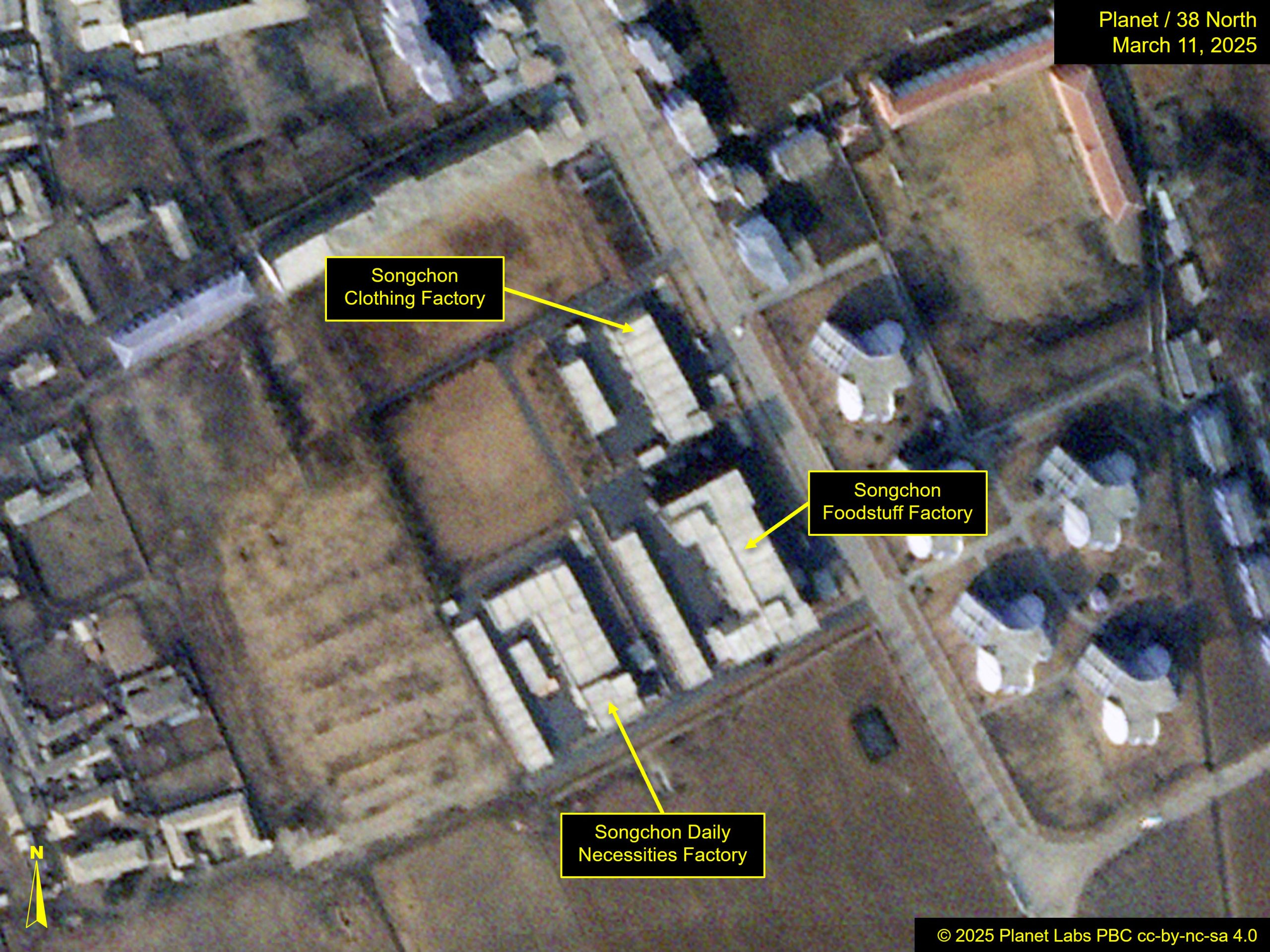
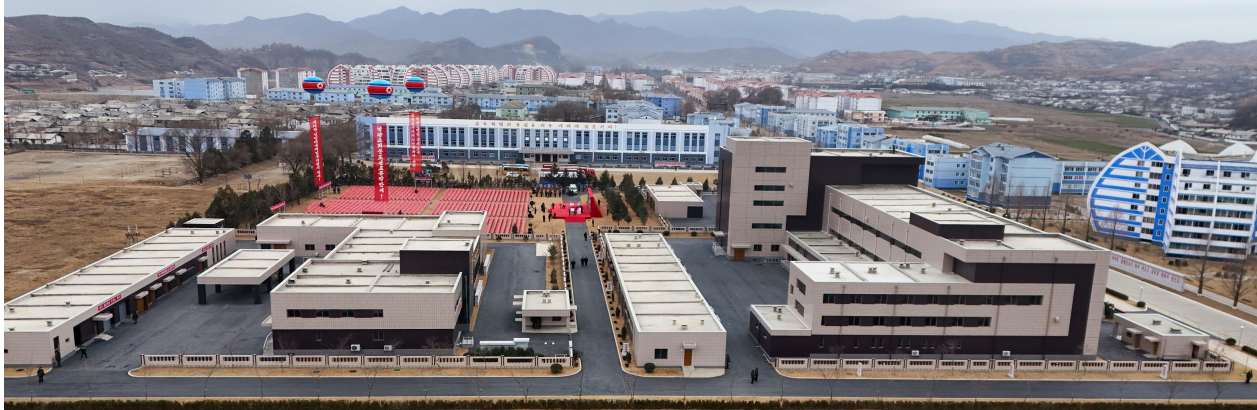
As these rural development programs are being carried out, the construction progress can be easily verified on commercial satellite imagery. In Songchon, for example, both the new hospital and factory complexes are easily visible and match the images broadcast on state television.
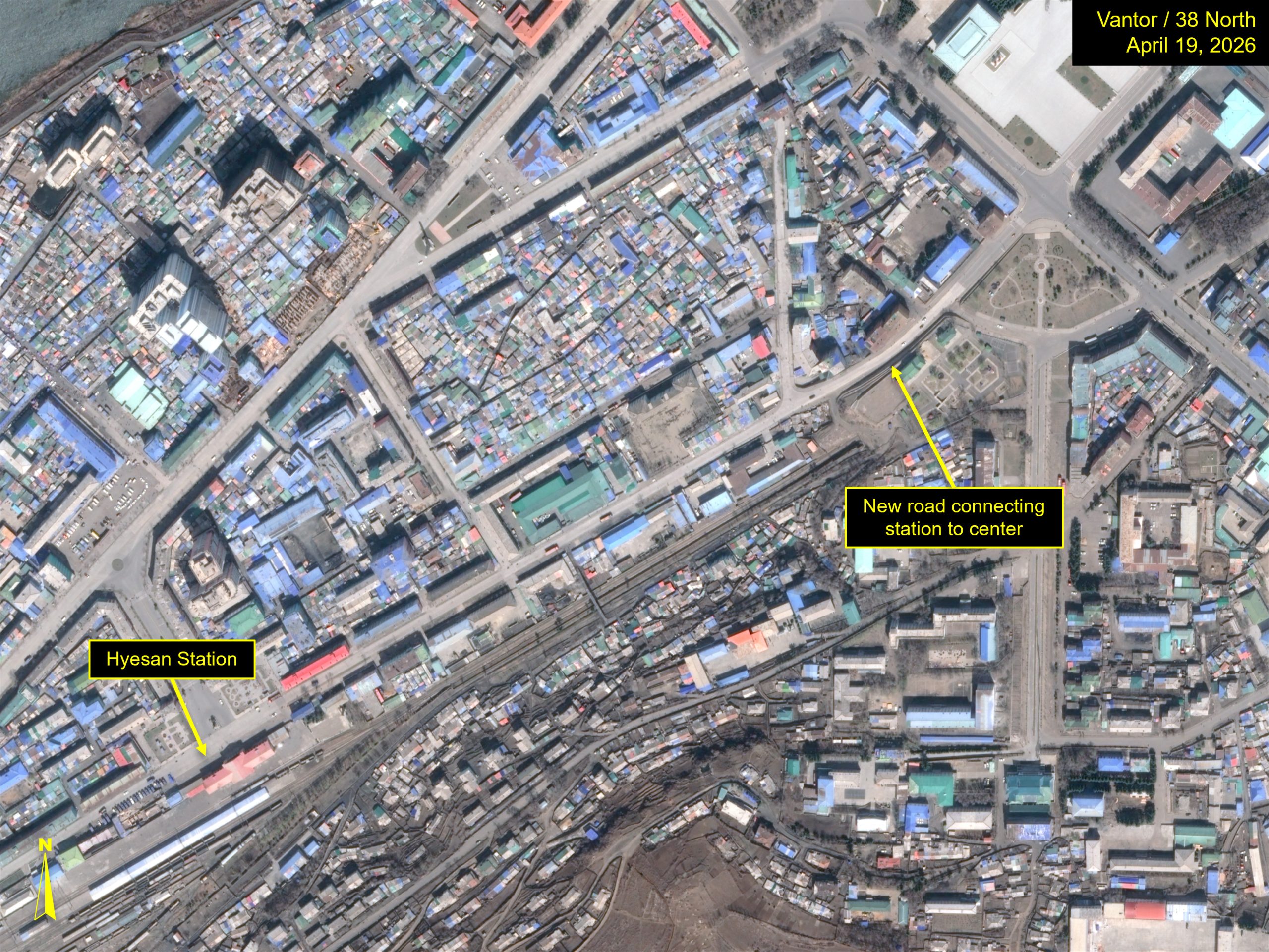
Other work reported by North Korean media can also be verified, such as in Hysean where a new road was constructed to link the Hyemyong District and Hyesan Youth Railway Station under the banner of rural development. The work also included adding a central reservation to a road that leads directly to the town’s central square and leadership statues.
But that is the extent to which satellite imagery can be used to verify these projects. What cannot be seen, and what will determine the enduring legacy of the 20×10 initiative, is a question of resources: whether local communities can keep these factories and facilities running after the opening ceremonies.
As noted in the guidance, most of the responsibility for raw material supply and factory operation falls to local authorities. For example, it calls on the provincial people’s committees to plant paper forests “of 800–1,500 jeongbo” (1 jeongo is roughly 1 hectare), and for city and county people’s committees to create “oil crop areas of 500 jeongbo or more” and for foodstuff factories to create 50–100 jeongbo of crops.
The emphasis on local production of raw material aligns with the state’s aim to raise the level of regional industry. Each factory is creating a local supply chain rather than relying on materials shipped from elsewhere.
Another important challenge is the supply of electricity needed to keep these new facilities running. North Korea is energy starved and households receive a fraction of their required electricity, especially in the rural regions. Factories are supposed to enjoy better supply, but at least one report says a regional industry factory is down to working only three hours a day due to lack of power.
Ultimately, for Kim Jong Un to really eliminate the “backwardness” of the rural areas as his grandfather long ago aspired to do, it will take more than new buildings and showy ceremonies. Factory and facility upkeep, power, supply chains, workforce training, and more will all need to be in place for any kind of meaningful and sustainable success.
This research was sponsored by The UniKorea Foundation.
- [1]
“Change Brought by Rural Thesis,” Korean Central News Agency, February 25, 2009.