

Saying It With Pictures: North Korea Flashes Its Latest ICBM, Old “New” SLBMs, and “Tactical Nuclear Attack” Sub
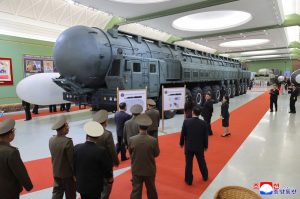
North Korean media announced the October 11 “inauguration” of the “National Defense Revolution Museum” by Kim Jong Un, apparently located in a purpose-built tunnel facility in central North Korea near Myohyangsan. The announcement contained no details of the weapons displayed in the museum, but the accompanying photos depicted various missile systems. The new, untested, Hwasong-20 (HS-20) solid-propellant, road-mobile intercontinental ballistic missile (ICBM) was clearly intended to be the star of the show. Placards seen in the photos depicted the missile as having a range long enough to reach beyond the US into South America (consistent with previous assessments), and as having a multiple independently targetable reentry vehicle (MIRV) payload with six reentry vehicles (RVs)—a new revelation. North Korea has yet to successfully test MIRVs, and the apparent HS-20 RVs may not be large and blunt enough for the North Koreans to be highly confident they would withstand reentry without full-range flight-testing on ICBM trajectories. The museum display also included five types of submarine-launched ballistic missiles (SLBMs), including one described in some western media reports as “new” that probably was actually a previously-displayed type that has yet to be flight-tested.
Pyongyang separately announced an October 14 launch of “two kinds of submarine-launched strategic cruise missiles” without providing details. But accompanying photos implied that the “tactical nuclear attack sub” revealed in September 2023, converted from an old ROMEO-class diesel/electric sub, had begun sea trials, during which it launched one cruise missile from its vertical launch tubes and one from its traditional torpedo tubes. Sea trials generally take about a year to complete, and presumably will include a launch of the ballistic missiles the converted sub also apparently carries. The torpedo tube launch underscores the potential for nuclear cruise missiles to be deployed on other subs.
It is unclear why North Korea used photos to indirectly telegraph these programs while providing no details. Perhaps a subtle reminder of its nuclear weapons and capability to strike the US was regarded as enough, or there were not enough new missile achievements to brag about yet. MIRVs remain the most significant potential future missile development, and Pyongyang telegraphing that the HS-20 will carry MIRVs is an important reminder that it seeks an increasingly credible capability to target the continental US despite missile defenses.
Highlighting An Untested ICBM
Appearing in six of the 23 photos that included some sort of missile system, the as-yet unflown HS-20 ICBM was clearly intended to be the star of the museum media display. The missile, missile canister, and transporter-erector-launcher (TEL) vehicle appeared to be the same as those previously displayed at the “military hardware exhibition Defense Development-2025” and a military parade in Pyongyang in October 2025. But the photos did convey two notable things:
- A placard seen at the HS-20 exhibit apparently displayed missile range arcs extending from North Korea across the entire US and into South America, consistent with previous range estimates based on the missile’s size relative to the previously-flown HS-18 and HS-19 solid ICBMs already assessed to be able to reach that far.
- A second placard, when magnified, appeared to show a MIRV payload with three sets of two reentry vehicles (RVs), with one RV in each set facing forward and one aft. The HS-20’s use of a longer booster and a blunter payload shroud than the two earlier solid ICBMs previously suggested it would be intended for a MIRV payload, and one that was larger than that of the HS-19. The latter missile apparently carried a post-boost vehicle (PBV) for dispensing MIRVs in its first and only flight-test in October 2024, although how many RVs, if any, were carried in the HS-19 test is unknown—and no RV reentries were reported.
It remains to be seen when the HS-20 begins flight-testing, and whether and how many RVs it releases. Despite announcing multiple warhead missiles as an objective in January 2021, North Korea has yet to conduct a successful MIRV flight-test. A testbed booster launched in June 2024 that the North claimed to have dispensed three RVs and a decoy probably failed before any objects could have been released, and as noted above the single HS-19 flight apparently released no RVs. At least several successful flight tests over a minimum of a few years would likely be required before Pyongyang would be able to deploy operational MIRVs.
Another issue concerns the apparent HS-20 RVs themselves. Although the magnified image is quite blurry, the depicted RVs may not be large and blunt enough for the North Koreans to be highly confident they would withstand reentry and operate properly on ICBM trajectories without successful full-range flight-testing. (To date, the North has only flown ICBMs on highly lofted trajectories with a much shorter range that expose RVs to ICBM-like reentry temperatures and pressures for a much shorter time.) This may mean that Pyongyang would need to conduct full-range flight-testing of such RVs at some point, which could result in major political blowback. It might instead try to have its RVs flown on Russian boosters or try to obtain Russian (or Chinese) know-how to be able to design smaller, less blunt RVs that it could be sufficiently confident would function on operational ICBM trajectories without full-range test flights.
A “New” SLBM That Probably Isn’t
Some media reports claimed that the museum display also included a “new” SLBM, implying a missile that has not been seen before. The putative “new” missile was displayed in the center of the SLBM portion of the museum, flanked on the left by the previously-flown Pukguksong-1 and -3 SLBMs, and on the right the previously-paraded but unflown Pukguksong-4 and probably the previously-flown naval version of the KN-23 short-range ballistic missile (SRBM; the HS-11S). But the missile in the center probably is either the previously-paraded but unflown Pukguksong-5 SLBM or the larger, unnamed SLBM presumably designated Pukguksong-6. This is consistent with the apparent diameter of the missile in the center of the display relative to the height of a nearby person, although the length of the missile is harder to judge due to the angle of the photo.
Despite the apparent lack of a truly new missile, the SLBM display and its inclusion in the published photos suggests that North Korea remains committed to its pursuit of ballistic missile submarines. It remains to be seen when the nuclear-powered ballistic missile submarine (SSBN) last shown by the North in a construction hall in December 2025 will emerge, how long it will take to become operational, or what SLBM it will carry. Pyongyang’s other class of ballistic missile submarine apparently intended for operational deployment will be discussed below.
“Tactical Nuclear Attack Submarine” On Sea Trials?
On October 15, North Korean press reported the test-firing of “two kinds of submarine-launched strategic cruise missiles” in order to “examine the current mobilized posture of the underwater combat systems.” No other details were provided, but an accompanying photo showed the “tactical nuclear attack submarine” converted from an old ROMEO-class diesel/electric attack sub, which had been rolled out of its construction hall and launched in September 2023, underway on the surface at sea. Other photos showed a cruise missile having emerged vertically from the water, and another having emerged horizontally at a shallow angle above the water.
The combination of the press item and photos imply (and the North almost certainly intended to signal) that the converted missile sub has begun sea trials; this is the first positive indication that the sub had left its construction and fitting-out port at Sinpho, where it was last seen in commercial imagery in August. The vertically-launched cruise missile presumably came from one of the six smaller-diameter vertical launch tubes seen on the sub, which also is equipped with four larger-diameter vertical tubes apparently for the KN-11S SRBM or perhaps the Pukgukson-1 or -3 SLBMs. The horizontally-launched cruise missile apparently came from the missile sub’s traditional horizontal torpedo tubes, a capability previously shown by North Korea in a March 2023 launch from the GORAE-class missile test sub. The photos also showed that the cruise missile had been launched from inside a canister that had been ejected from the torpedo tube, a common method the US and other countries use to ease the storage, handling, and launch of torpedo tube-fired missiles—but one not seen in the photos from the March 2023 launch.
It is unclear why it took about three years for the converted missile sub to begin sea trials, which generally take about a year to complete, or why Pyongyang did not publicize the sea trials more extensively, as it has with its new destroyer surface combatants. Presumably at some point, the sea trials will progress to an underwater launch of whatever ballistic missile presumably is carried in the larger-diameter launch tubes. Although Kim Jong Un suggested in September 2023 that “all” remaining ROMEO-class subs (up to 19) would be converted to missile subs, there is no open-source reporting additional conversions have been taking place. The conduct of another apparent torpedo tube launch of a “strategic cruise missile” (presumably a Hwasal-class land-attack cruise missile [LACM]) underscores that North Korea has the option of deploying LACMs—even nuclear-armed ones—on general-purpose attack submarines, as it has done with its corvette- and destroyer-sized general-purpose surface combatant ships.
The Bottom Line
It is unclear why North Korea used photos to indirectly telegraph these programs while providing no details. Perhaps a subtle reminder that it is continuing to pursue these programs, despite mostly launching SRBMs and LACMs over the past two years, was regarded as sufficient to underscore its commitment to nuclear weapons and ability to strike targets in the US. Perhaps the lack of HS-20 flight-testing, the absence of the new ICBM-range solid-propellant SLBM foreshadowed in January 2021, the long delay in sea trials of the converted missile sub, and the continued presence of the SSBN in its construction hall meant that there was not much new for Pyongyang to brag about yet. MIRVs remain the most significant potential future development in the North Korean missile force, given their ability to further complicate the task of allied missile defenses and increase the number of targets that the missile force can strike with a given number of missiles and launchers. Pyongyang telegraphing that the HS-20 will carry MIRVs is an important reminder that it seeks an increasingly credible capability to target the continental US despite missile defenses.